The short version of how we work with you and your information.
Terms & conditions
01
Acceptance of terms
By using our services you agree to be bound by these terms. If you do not agree, please do not use our services.
02
Services provided
We provide software engineering, AI development, product design, and team augmentation services. The details of each engagement are agreed in writing before work begins.
03
Appointment booking
When you book an appointment you agree to provide accurate and complete information about your project, including tech stack, scope and timeline.
04
Changes to terms
We may modify these terms at any time. Changes take effect on posting, and continued use of our services constitutes acceptance.
Privacy policy
Privacy policy to be added. Add your full privacy policy here before launch: what data the site collects, how enquiries are stored, how long they're kept and how people can ask for deletion.
Software, AI &platformsagentsMVPsteamsbuilt to hold up.
Z-Axiss builds enterprise platforms, AI systems, and apps for organizations across the US and worldwide. From government and healthcare to mobility, education, and commerce, we engineer robust software built to last.
Domain expertise that shortens the learning curve.
Whether you operate in municipal enforcement, clinical care, education, or commerce, we learn how your business actually runs before writing a single line of code.
8+
Years building softwareSince 2018
15+
Clients servedIn the US and around the world
20+
Projects deliveredFrom first idea to daily use
What we do
Full-stack engineering under one roof.
We act as your dedicated product team, taking full ownership of architecture, delivery, and long-term stability.
AI agents & applied AI
AI built into the systems you already run. We build production-ready agents, LLM-powered features, and document intelligence that handle your day to day workflows on secure, governed, and observable foundations.
Full delivery of a platform, from the domain model through to the interface people use all day. We take responsibility for how the system behaves, not just whether it compiles.
Domain modelingArchitectureBackend & APIsWeb & mobile appsAutomated testing
Developers, testers, and project managers who work as part of your team and follow your processes. Add the skills you need, scale your team when required, and keep delivery moving without a lengthy hiring cycle.
AI agents that plan, execute, and hand off work inside your existing systems.
We build AI agents that take on routine work inside your existing systems, such as reading documents, routing requests, and asking a person to approve before anything important happens. You can see what each agent did, why it did it, and what it cost.
Built withGoogle ADKLangGraphOpenAI Agents SDKCustom Python & TypeScript
A clean air zone charging and exemption platform that helps reduce high-polluting vehicle use while supporting essential hospital and emergency journeys.
Uses NLP to extract tags and keywords from examination questions, so educators can organize and analyze assessment content at scale. It learns from feedback.
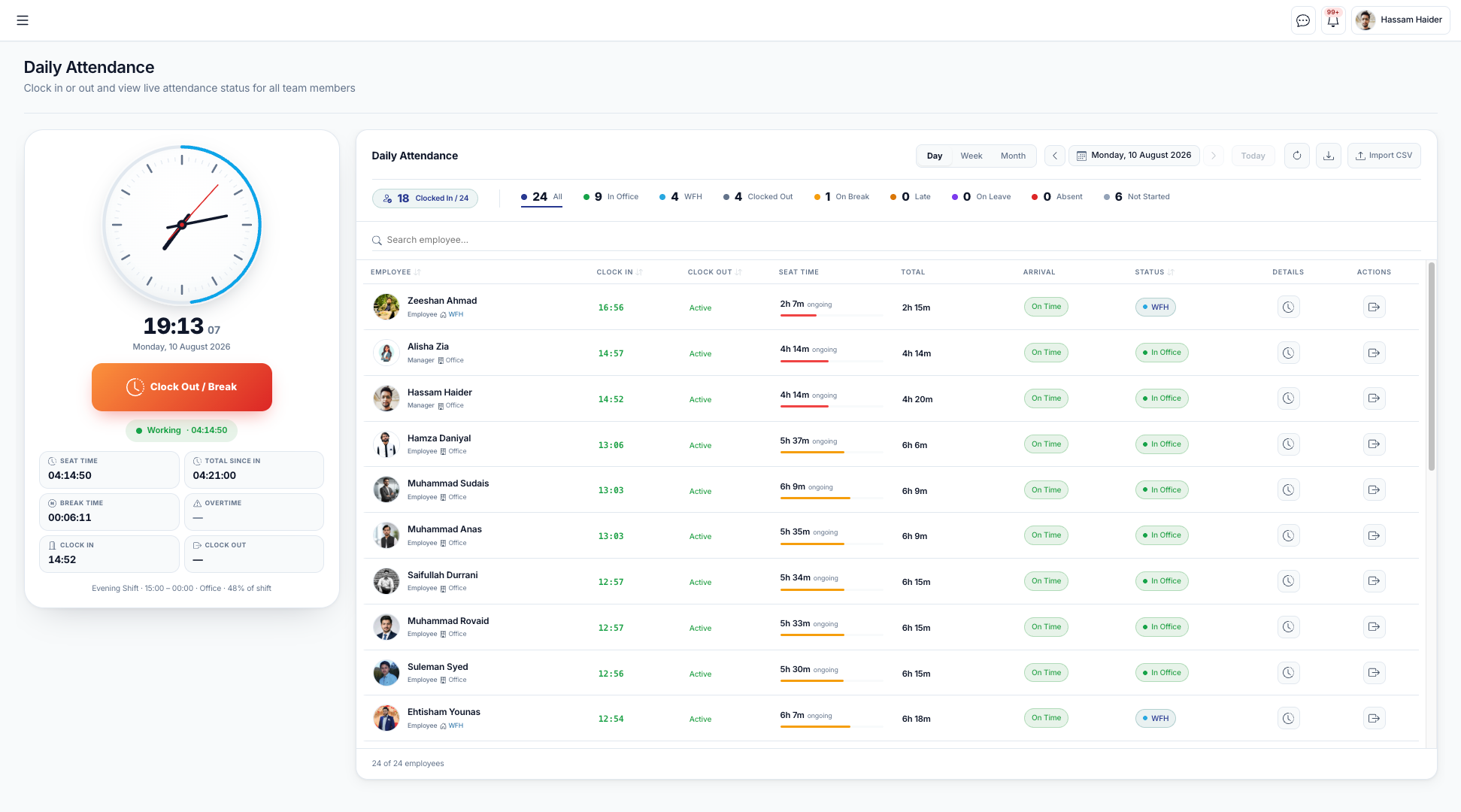
Staff attendance, leave, and asset tracking for any organization, with location-verified clock-ins, leave balances that always add up, and a complete audit trail.
Client work stays the client's. We built these platforms under contract; the organizations that commissioned them own and run them.
Daily attendanceCompany-wide · today
112Checked in
6Late
9On leave
Employee A · 09:02Checked in
Employee B · 09:41Late
Our product
Employee Management Portal: Built by Z-Axiss, hosted on your servers
Manage staff attendance, leave balances, company hardware, and internal updates in one self-hosted platform. You keep 100% control of your data on your own infrastructure while our team handles updates and new features.
A clear, milestone-based path from your first architecture call to post-launch scaling, with you involved at every stage.
01
Discovery & Architecture
We map your workflows, edge cases, and compliance requirements before any code is written. You receive a clear technical specification and system architecture, refined with you in regular working sessions until it reflects your goals.
02
Roadmap & Team Setup
Within days, you receive a fixed-scope milestone plan, a written quote, and the named engineers who will build your product.
03
Two-Week Sprint Delivery
We ship working, testable software every two weeks. You review live builds in staging, share feedback, and follow progress in a shared backlog, so you stay close to the work throughout development.
04
Launch, Telemetry & Scale
We manage deployment, CI/CD pipelines, and live monitoring. After launch, we stay alongside you to optimize performance, respond to changing needs, and ship new features as your user base grows.
Our mission
To build software organizations can depend on: systems that do a real job every working day, and still hold up years after launch.
Understand the domain
We learn the rules of your business before we write a line of code around them.
Build to be trusted
Every decision a system makes is recorded, explainable and ready to be audited.
Stay for the long run
We measure success by how well a system runs in year five, not how it demos on day one.
Engineers, designers and delivery leads working from Islamabad on platforms used across the United States and beyond.
It depends on scope and integrations. A focused MVP usually takes a few months, and enterprise platforms take longer. After the first call you get a clear roadmap with milestones, not a vague estimate.
Yes. We add AI agents, AI-powered features, and document intelligence to platforms you already run. Your documents and data are used only to run your own system, AI services are set up so your data is not used to train their models, and when data cannot leave your environment, we can host the models inside it.
No. Our working hours overlap every day with UK, EU, and US East Coast teams. You get one accountable lead as your main contact, and you can follow progress through live builds and a shared backlog at any time.
You own the code and IP. Client work is built under contract, and NDAs and IP assignment are standard. If you later move the project to an in-house team, we hand over the source code, documentation, and deployment setup, so you are never locked in.
It depends on the scope, the team you need, and how long you need it. We offer fixed-scope projects, monthly retainers, and dedicated engineers, and you receive a written quote before anything is signed.
Send us a message or book a call. We discuss your goals and come back with an approach, a suggested team, and a realistic timeline. Many clients start with one engineer or a small, clearly defined first piece of work before scaling up.
Ready to turn your idea into a product?
Free 30-minute call. Leave with an approach, a suggested team and a realistic timeline.
We design, build, and run software and AI for enterprises, growing businesses, and technology startups. Since 2018, we have helped organizations across many industries launch products faster and more cost-effectively.
We build AI agents, AI-powered features, and document intelligence that connect to your existing platforms and workflows. Every decision is recorded, so you can see what each model decided and why.
AI agents that fit your tools. Agents that take on routine operational work such as triage, support, data entry, and reconciliation, working together when a task needs more than one. We build with Google ADK, LangGraph, the OpenAI Agents SDK, or your own stack.
AI in your existing products. Add search, summaries, and assistants to the products you already run, without rebuilding them.
Document intelligence. Read contracts, forms, and reports automatically and pull out the details that matter, so your team can find answers without digging through files.
AI observability. Track the cost, quality, and every decision your AI makes, with a person reviewing the cases that matter.
Private deployment. We can host models inside your own environment when your data cannot leave it.
We build software that meets your requirements and holds up in daily use. We take responsibility for how it behaves in the hands of the people who rely on it every day.
Domain knowledge first. We learn the rules of your field, such as enforcement, clinical, academic, or commercial, before we design around them.
Architecture that fits the problem. We choose the structure, from a single well-organized application to separate services, based on what your project needs rather than what is fashionable.
Backend and integrations. The behind-the-scenes systems, data flows, and connections that link your new software to the tools you already use.
Web and mobile. One core system, delivered through whichever channels your users need.
Tested business rules. Automated tests protect the logic that matters most and run every time the code changes.
03. Team augmentation
Engineers who become part of your team.
Add skilled people to your team and keep delivery on track and on budget, without the cost and delay of building a whole department.
Developers, testers, and project managers
You choose the roles you need, not a fixed package.
Inside your process
Our engineers follow your team meetings, coding standards, and your own rules for when work counts as finished.
Agile delivery
Short work cycles, visible progress, and room for change without starting the conversation from scratch.
Scale both ways
Add skilled people when you need extra capacity, then scale back when the workload settles, without going through another hiring process.
04. Ideation & MVP
From idea to something users can try.
We help you shape your idea and turn it into a working first version that real users can try. You get early feedback, see what works, and make informed decisions before moving to a full launch.
01
Shape
We work through your idea together and finish with a prioritized list of features, not a wish list.
02
Build
A working first version built around the essentials, ready for the people it is designed to serve.
03
Learn
We gather feedback from actual use, so the next version is based on evidence rather than guesses.
04
Scale
We strengthen what worked and drop what did not, then prepare for the full launch.
2weeks
AI readiness sprint
We find where AI can take work off your team, build a prototype of the strongest idea, and give you a plan with costs.
We research and test with the people who will use the system, so the result is easy to use, not just functional.
UI/UX design
User research and usability testing that lead to designs which are simple to learn and pleasant to use.
Research & testing
Wireframes & prototypes
Design systems
Digital transformation
We review your current systems and build a roadmap that matches technology to your business goals, rather than replacing tools for the sake of it.
Systems assessment
Technology roadmap
Websites & web apps
Websites and web applications designed to make it easy for your customers to find what they need and get things done.
Custom websites
Web applications
06. Cloud & DevOps
Shipping should be boring.
We automate workflows, shorten time to market, and improve the reliability of the software you already run. DevOps works alongside our development and cloud engineering, so architecture, deployment, and operations stay connected from the start.
Automated releases (CI/CD)
Automated release pipelines that make launching updates simple, fast, and reliable.
Consistent environments
Your software works reliably wherever it runs, from development to production.
Monitoring
Monitoring that catches problems before your users report them.
Cloud
Enterprise-grade cloud support through our partnership with Trillo AI, a Google Cloud Partner.
Technologies
The technologies your project needs.
Our team has hands-on experience across web, mobile, AI, data, and cloud, ready to fit into your plans.
How we engage
Three ways to start.
Discovery
Scope a problem
You have a business problem but no fixed solution yet. We turn it into a clear technical plan, a roadmap, and a cost estimate.
Digital products for organizations across industries.
Every project below was designed and engineered by Z-Axiss for a client, and is owned and operated by that client. Grouped by the industry it serves, because the domain is what shapes the system.
Industries we serve
Where our work goes.
Real experience in industries where compliance, scale and daily reliability all have to work together.
Every case study on this page is client work. We designed and built those platforms under contract, and the organizations that commissioned them own and run them. Entries marked as a product or capability are the exception: those are software Z-Axiss owns, or a capability we offer rather than a delivered client project.
Working on something in your sector?
We have taken systems live in enforcement, healthcare, education and commercial marketing. Tell us the problem and we'll tell you honestly whether we're the right team.
Every hour, every absence, every asset, accounted for.
Attendance, leave, assets and internal communication in one self-hosted system, built and supported by Z-Axiss and configured to how your organization actually works.
On site, verifiedWithin graceNo short hours1 exception to review
A defensible record rather than a punch time. Every override keeps the original calculation on file.
Overview
One system for the work that surrounds the work.
Most companies run attendance in one tool, leave in another, equipment in a spreadsheet and announcements in a chat thread nobody can search. Nothing reconciles, so every payroll cycle turns into an investigation.
The portal puts all of it in one place, with three purpose-built views so people only see the part that is theirs, deployed on your own infrastructure, with no per-seat license.
9Modules covering the full employee day
3Role portals, plus an API role
7Built-in report types, exportable
MultiCompany support, one login
Three portals
Everyone sees their part of it, and nothing else.
For employees
Clock in, request, check, done
Clock in and out, see today's shift and hours
Live leave balances and request history
Explain a late arrival before anyone asks
See assigned equipment and confirm receipt
For managers
Their team, decided today
Who is in, late, absent or on leave, right now
Approve leave, excuse lateness, review absences
Team calendar before approving overlaps
Team-only reports and balances
For administrators
The rules, and the receipts
Shifts, leave types, quotas, fiscal years, locations
Accounts, roles, invitations and access
Company-wide attendance, leave and asset data
Corrections and exports with a full log
The modules
Everything the working day actually touches.
Modules that share one set of people, one policy layer and one audit trail, so a clock-in, a leave balance and a laptop handover all reconcile against each other.
Platform & deployment
Built to run on your infrastructure, on your terms.
A complete application you own and deploy, not a seat-based subscription with your workforce data in someone else's account.
RUN
Deployment
Containerized, started with a single command, on your servers or a managed host.
DB
Data ownership
A PostgreSQL database you control, with schema upgrades applied on release.
API
Open API
A documented REST API with a dedicated integration role for payroll, HRIS or BI.
INT
Integrations
Google Calendar, Google Chat, email delivery and CSV import for historic data.
SEC
Security
Token authentication, hashed passwords and per-company isolation at the query layer.
QA
Quality
An automated suite covering business rules, permissions and isolation on every change.
UX
Experience
Responsive throughout: phones for clocking in, desktops for administration.
FIT
Adaptable
Modules, fields and rules extended to fit how you already work.
How we deliver it
You are not buying a download.
Z-Axiss implements the portal end to end, and stays with it afterwards.
01
Discovery & policy mapping
Your shifts, leave types, entitlements and approval chains mapped onto the configuration first.
02
Deployment & migration
Installed on your infrastructure or ours, with historic records imported at go-live.
03
Customization
Extra modules, fields, reports and integrations from the team that built it.
04
Training & support
Role-based onboarding plus ongoing maintenance and upgrades.
Request a demo
See the portal running on your own scenarios.
Tell us about your organization and we'll walk you through the modules that matter to you, with your shift and leave rules in mind.
A working session, not a slide deck.
Configured against your shifts and leave policy.
Deployment and migration questions answered directly.
A software company built on doing the difficult parts properly.
Z-Axiss is a software product engineering company in Islamabad. Since 2018 we have grown from a small team into a delivery partner for organizations that need systems to hold up under real operational load.
The company
Software that has to work on the day it matters.
Since 2018 we have built our reputation one delivered system at a time, through steady work rather than rapid marketing.
We specialize in enterprise platforms, AI systems, and custom web and mobile applications. Our reputation comes from professionalism and a steady commitment to quality.
As demand for digital operations grows, so does the need for prompt and effective solutions. We guide clients through the whole journey, not just the build.
2018
FoundedIn Islamabad, Pakistan
15+
Clients servedIn the US and around the world
20+
Projects deliveredFrom first idea to daily use
Our partnerships
Enterprise capability, a team that cares about the details.
As a partner of Trillo AI, a recognized Google Cloud Partner, and Dream AI, we pair enterprise cloud and AI capability with a team small enough to care about the details.
Frameworks that cut cost and timeOur engineers build on platforms that significantly reduce development cost and time.
MVP-first deliveryWe use that speed to take clients from concept to market through our MVP framework.
Delivered into the USPlatforms in operational use by municipal authorities and private operators.
How we work
Why clients choose us.
We don't just build software; we craft solutions tailored to the business behind them, whether you're a start-up launching a first product or an enterprise extending its digital capability.
Domain first
We learn the rules of your field before we write code, so the system fits how your work actually runs.
Systems that stay in use
Most of what we have built is still running every day, and we stay with it after launch.
One accountable lead
One main contact, a shared backlog, and live builds you can check at any time.
Security & standards
Built to be audited, from day one.
Compliance is a design constraint we build around, not a layer added before launch. Systems record how a decision was reached, and that is what survives a challenge.
AUDIT
Full audit trails
Every decision, change and approval recorded with who, when and why.
HEALTH
Healthcare data
Access controls, encryption and secure records handling for clinical workflows.
PRIVACY
Privacy by design
Consent, lawful processing, retention and deletion built into the data model.
SECURE
Secure engineering
Security reviews against common web and mobile vulnerabilities before release.
ACCESS
Accessibility
Interfaces that work for people using assistive technologies.
AI
Governed AI
Model decisions logged, monitored and explainable, with human review where it matters.
CI/CD
Controlled releases
Automated tests and pipelines so every change is traceable and reversible.
SUPPORT
Operational readiness
Monitoring and support so systems keep running long after launch.
Meet the people behind the systems.
Engineers, designers and delivery leads working from Islamabad.
Engineers, designers and delivery leads working from Islamabad on platforms used across the United States and beyond.
Working here
We hire engineers who want to own something.
Our teams work close to the domain, such as enforcement rules, clinical workflows, and assessment logic, because that is where the interesting engineering problems actually live. If that appeals, we'd like to hear from you.
Close to the domainYou'll learn the rules behind the software, not just the ticket.
Design and engineering togetherDesigners and engineers shape the product side by side.
Work that stays in useMost of what we build is still running years later.
AI in productionReal work on agents, LLM features and observability.
Your offshore engineering team, under your brand.
For agencies, consultancies and software companies that need senior delivery capacity. We work inside your process, and your client relationship stays yours.
A recognized Google Cloud Partner and the company behind Trillo AOS, an agent orchestration platform. Together we deliver enterprise cloud and agentic AI projects, with Z-Axiss engineers working inside the platform.
Google Cloud PartnerAgent orchestrationEnterprise delivery
AI & machine learning partner
Dream AI
An AI and machine learning software company building systems on cloud platforms and on-premises for enterprises across many industries.
AI & ML systemsCloud & on-premisesEnterprise AI
Partners, not just vendors. Through Trillo AI, a recognized Google Cloud Partner, and Dream AI, our clients get enterprise cloud and AI capability with a Z-Axiss delivery team that stays close to the work.
Writing from the people who build the work: architecture decisions, domain modeling, interface design and what we've learned shipping into environments where the output gets challenged.
Tell us what you are building.
Send us the problem and a member of the team will come back to you directly.
The short version of how we work with you and your information.
Terms & conditions
01
Acceptance of terms
By using our services you agree to be bound by these terms. If you do not agree, please do not use our services.
02
Services provided
We provide software engineering, AI development, product design, and team augmentation services. The details of each engagement are agreed in writing before work begins.
03
Appointment booking
When you book an appointment you agree to provide accurate and complete information about your project, including tech stack, scope and timeline.
04
Changes to terms
We may modify these terms at any time. Changes take effect on posting, and continued use of our services constitutes acceptance.
Privacy policy
Privacy policy to be added. Add your full privacy policy here before launch: what data the site collects, how enquiries are stored, how long they're kept and how people can ask for deletion.
New · Agents on any framework
AI agents that do the work, not just the talking.
We design, build and run AI agents that plan, use your tools, hand off to each other and ask a human when it matters. We choose the framework to fit your stack, and engineer the result like the rest of our software: tested, observable and built to be audited.
Work that currently lives in inboxes, spreadsheets and swivel-chair tasks.
An agent is worth building when a process has clear rules, a lot of volume and a real cost when it's slow or wrong. These are the places we start.
Operations & back office
Reconcile records, chase missing data, update systems and flag exceptions for a person to decide.
Customer & case support
Triage requests, draft answers from your knowledge base and route the hard ones with full context.
Document processing
Read contracts, forms and reports, extract what matters and file it where it belongs.
Sales & CRM operations
Enrich leads, prepare account briefs and keep the pipeline clean without manual data entry.
IT & DevOps
Investigate alerts, gather logs, suggest fixes and open tickets with the evidence attached.
Compliance review
Check records against policy, explain every finding and leave the decision with a reviewer.
How we build
Production agents, on the framework that fits you.
We are not tied to one vendor's toolkit. We have the most production mileage on Google's ADK, and we build just as readily on LangGraph, the OpenAI Agents SDK or Microsoft's Agent Framework, or straight against model APIs when a framework would only add weight. The framework is a choice made in discovery; the engineering below is what stays constant whichever way it goes.
01 · Workflow runtime
Deterministic where it must be, flexible where it can be.
We compose agent logic as execution graphs (routing, fan-out and fan-in, loops, retries and nested workflows), so the steps that must happen in order always do, and the model only decides where judgment is actually needed.
Graph workflowsRoutingRetriesState management
02 · Multi-agent delegation
Specialists, not one agent that does everything.
An orchestrator hands structured tasks to specialist agents and gets controlled output back. Agents can also talk across systems and vendors over the open Agent2Agent (A2A) protocol.
Task APIAgent hierarchiesA2A protocol
03 · Tools & integrations
Agents that act inside your systems.
Agents get tools built from your own functions, OpenAPI specs and existing services, such as your CRM, ERP, databases, email and document stores, with permissions scoped to exactly what each agent needs.
Sensitive actions pause for explicit confirmation, with the agent's reasoning and evidence in front of the reviewer. Approvals, rejections and edits are all recorded.
Tool confirmationApproval queuesEscalation
05 · Evaluation
Tested like software, before and after launch.
We build evaluation sets from your real cases and run them on every change, so a prompt tweak or model upgrade can't quietly break a workflow that was working.
Eval datasetsRegression testsQuality scoring
06 · Deployment
Runs where your data is allowed to be.
Agents are containerized and deployed wherever the data is allowed to live: Google Cloud Run or Vertex AI Agent Engine, AWS, Azure, or your own infrastructure. Every framework we work with is model-agnostic, so the deployment target and the model provider stay separate decisions.
Cloud RunVertex AI Agent EngineAWS & AzureSelf-hostedModel-agnostic
We build withGoogle ADKLangGraphOpenAI Agents SDKMicrosoft Agent FrameworkMCPNo framework
Built inPythonTypeScriptJavaGoKotlin
Built to be audited
Every step an agent takes, on the record.
An agent you can't inspect is an agent you can't trust with real work. We instrument every run so you can see what happened, why, and what it cost.
Full traces. Every model call, tool call, handoff and decision, in order.
Cost & latency tracking. Per agent, per workflow and per customer.
Quality monitoring. Drift and failure alerts before users notice.
Governance. Scoped permissions, approval rules and a durable audit log.
Agent observability · run #4821
StatusCompleted
Duration18.4 s
Model calls6
Tool calls9
orchestrator.plan
research.search
data.query_sql
human.approve
action.update_crm
Agent response · rendered interface
Agent
InvoiceINV-2291
MismatchQty 40 vs 36
Approve creditEscalate
Adaptive agent interfaces
Agents that answer with a screen, not a wall of text.
Instead of chat replies, our agents can return structured interface specs, such as tables, forms, and approvals, that your app renders with its own trusted components. The model describes the UI; it never ships code that runs in your users' browsers.
Safe by design. JSON specs rendered by your own components, with no runtime execution of AI-generated code.
On-brand. Agent output looks like the rest of your product.
From idea to running agent
How an agent project runs.
01
Discover
We pick the workflow with the clearest value and map its rules, systems and risks.
02
Prototype
A working agent on your real data, with the human checkpoints agreed up front.
03
Evaluate
Tested against real cases until it meets the quality bar you set.
04
Deploy & operate
Launched with monitoring, cost tracking and ongoing improvement.
FAQ
AI agents, answered.
A chatbot answers questions. An agent works toward a goal: it plans steps, calls tools in your systems, checks results and hands off or escalates when needed.
Whichever suits the work. We pick based on your existing stack, where your data has to live, how much orchestration the workflow genuinely needs, and who will maintain it after we hand over. We have the most production mileage on Google's ADK, and we work the same way with LangGraph, the OpenAI Agents SDK and Microsoft's Agent Framework. Some workflows are better served by plain code against a model API, and we will say so.
No. You own the source, the agent definitions and the evaluation sets outright. We keep orchestration logic separate from any one SDK and put models behind an interface you can swap, so changing framework or provider later is a migration rather than a rewrite.
Any of the major providers (Gemini, GPT, Claude) or open-weight models you host yourself. We choose per task, balancing quality, speed, cost and where your data is allowed to go, and we re-test when a better option appears.
Yes. Agents connect through APIs, databases and existing services, with each agent given only the permissions it needs.
Sensitive actions require human approval, every run is traced and logged, and you can see exactly what an agent did and why.
Yes. We deploy on Google Cloud, or in your own environment when data can't leave it.
Find the first workflow worth giving to an agent.
A 2-week AI readiness sprint: we map the opportunities, prototype the strongest one and hand you a costed plan.
There is a version of this industry where the goal is to get to launch.
Hit the date, take the photograph, move the team onto the next thing.
We have never worked that way, and the reason is simple: almost
everything we have built is still running.
The bill arrives later
A civil enforcement platform issues notices that get appealed months
after the fact. A telehealth system holds records a clinician will
open years after the consultation. A leave ledger has to reconcile in
the fourth fiscal year as cleanly as it did in the first. None of
those obligations exist on launch day. All of them are decided by
choices made long before it.
That is why we spend what looks like a disproportionate amount of time
on the parts of a system nobody demos: the audit trail, the
correction workflow, the migration path for historic data. Those are
not features you sell. They are the difference between a platform that
ages well and one that quietly becomes a liability.
Software that cannot explain itself becomes a liability the moment somebody asks it to.
Ownership changes the incentives
We hand over source, documentation and the automated test suite. Our
clients own what we build outright, and our own products are deployed
on their infrastructure rather than rented back to them by the seat.
That is partly principle and partly practical: a team that knows the
client can walk away builds differently from one that assumes they
cannot.
It also keeps us honest about complexity. When you know somebody else
will maintain the system, you stop being clever for its own sake.
Small team, long horizon
We are a partner of Trillo AI, a recognized Google Cloud Partner, which
gives us enterprise cloud capability behind a team small enough to
care about the details. Our engineers sit close to the domain, such as enforcement rules, clinical workflows, and assessment logic, because that is where the decisions that matter actually get made.
If you are choosing a partner, the question worth asking is not how
fast they can ship the first version. It is what the system looks like
in year three, and who will still understand it.
Most requirements describe what a system should do. In civil
enforcement, that is not enough. The system also has to be able to
explain, months later, why it did it, to somebody who disagrees.
The appeal is part of the workflow
When we worked on the Vehicle Management System, the thing that
reshaped my approach was realizing that a notice is not the end of a
process. It is the start of one. Notices get appealed. Officers get
challenged. A record that says violation: yes is worthless if
it cannot also say which rule was applied, what the input was, and
who reviewed it.
So we stopped writing acceptance criteria that ended at the outcome.
Every rule got a second criterion: given this decision, can a
reviewer reconstruct how it was reached from the record alone?
Rules belong to the client, not the codebase
Parking conditions differ by site. Grace periods differ by shift.
Leave entitlements differ by grade. The instinct is to encode the
first version you are told about, and the consequence is a change
request every time policy moves.
The better question during discovery is not "what is the rule?" but
"who changes this rule, and how often?" If the answer is anyone other
than an engineer, it belongs in configuration. That one question has
saved more delivery time than any process I have introduced.
Ask who changes the rule, not just what the rule is. The answer tells you where it belongs.
Override, never overwrite
Every operational system needs a way for a human to disagree with it: to excuse a late arrival, reverse an automatic absence, correct a
record entered in error. The failure mode is letting that override
erase the original.
Keep both. The system's calculation, the human's decision, the reason
and the reviewer. It costs almost nothing at write time and it is the
only thing that makes a difficult conversation fair, and provable.
Demo interfaces are built for a five-minute story with clean data.
Operator interfaces are built for somebody working a queue all day,
with data that is messy, incomplete and occasionally contradictory.
They are not the same product.
Density is a feature
The generous whitespace that makes a marketing screenshot look calm
becomes a liability when a case worker needs to compare twelve rows.
On enforcement and attendance screens we deliberately raise density:
more rows in view, tighter type, status carried by a colored token
rather than a full-width banner.
The test is not whether it looks pleasant in a screenshot. It is
whether somebody can scan forty records and spot the two that need
attention without scrolling.
Build the empty, loading and error states first
In Angular work especially, it is tempting to build the happy path and
treat everything else as polish. We do it the other way round now. If
a screen cannot answer "what does this look like with no data, slow
data, or a failed request?", it is not finished.
Operators lose trust in a system the first time it shows them a blank
panel with no explanation. Trust is very expensive to win back.
An operator will forgive an ugly screen. They will not forgive one that lies about what it knows.
Keep the keyboard in mind
Anyone processing volume will stop reaching for the mouse within a
week. Tab order, focus management after a modal closes, submitting
without hunting for a button. these are not accessibility
afterthoughts, they are throughput features. They also happen to make
the product genuinely accessible, which is the right outcome arrived
at from a practical direction.
None of this is exotic engineering. It is mostly the discipline of
building for the hundredth hour rather than the first five minutes.
Adding a model to a product is now the easy part. The hard part is the
interface around it, because the moment software starts making
suggestions, users need to know how much to trust them.
Review, not transcription
On ExamPro, the system extracts tags and keywords from examination
questions. The temptation is to present that as finished work.
We designed it as a review task instead: the tags arrive as
proposals, the educator confirms or corrects them, and those
corrections feed back into the engine.
The framing matters more than the accuracy figure. A user who
understands they are reviewing will catch the mistakes. A user who
believes the work is done will not look.
Show the work, not just the answer
Wherever a suggestion can be traced to something concrete, such as the phrase
in the question that produced a tag or the record a summary came from,
surface it. Users calibrate their trust from evidence, and a system
that shows its reasoning gets more useful corrections back.
Present a model's output as a proposal and users check it. Present it as a result and they stop looking.
Latency is a design problem
Model calls are slow and variable in a way that ordinary API calls are
not. A spinner that sits for eight seconds reads as broken. Streaming
partial output, showing what stage the work is at, and keeping the
rest of the interface usable while it runs are all front-end
decisions, not infrastructure ones.
And the feature must degrade honestly. If the engine is unavailable,
say so and let the user proceed manually. Silently returning nothing
is how a promising feature gets switched off by the people it was
built for.
The telehealth platform we built serves five distinct roles. Each one
arrives with a different job, a different vocabulary and a different
tolerance for complexity. The design problem is not building five
interfaces. It is building one system that can present five honest
views of itself.
Start from the job, not the data model
A provider and a patient can look at the same consultation record and
need almost nothing in common from it. The provider needs history,
prescribing and documentation. The patient needs to know what was
decided and what happens next.
When you design outward from the shared data model, everyone gets a
slightly wrong screen. When you design inward from each role's actual
task, the shared model does its job quietly underneath, which is
where it belongs.
Scope is a design decision before it is a permission
Role-based access is usually treated as a security control bolted on
at the end. It is more useful as a design constraint at the start. A
manager who only ever sees their own team does not need a filter for
everyone else. Removing that filter makes the screen simpler and the
permission model easier to reason about at the same time.
The five things this person needs, not the forty they do not: that is the whole brief.
The seams are where products fail
Most of the pain in multi-role systems lives at the handovers: the
prescription passing to a pharmacy, the lab order returning a result,
the leave request reaching an approver. Those transitions deserve more
design attention than any single screen, because that is where users
currently fall back on phone calls and email.
If a handover inside your product is slower than a WhatsApp message,
people will use WhatsApp, and your system stops being the record.
The quickest way to model a leave balance is a column holding the
remaining days. It works immediately, and it fails the first time
somebody disagrees with the number.
The column cannot explain itself
When a balance lives in a single field, every change overwrites the
evidence of the previous one. An employee asks why they have
eleven days instead of twelve and nobody can answer without digging
through logs, assuming the logs captured it at all.
In the Employee Management Portal we model it the other way round.
Entitlements are credited per fiscal year, and every approval,
cancellation, adjustment and unpaid deduction is written to a ledger
as its own entry. The balance is the sum of those entries. It is never
typed by anyone.
What that buys you
Disputes stop being arguments and become queries. Corrections stop
being edits and become compensating entries with a reason attached.
And historic data can be imported at go-live as opening entries
rather than as invented starting numbers.
The same shape applies well beyond leave: asset custody, enforcement
case state, anything where "how did we get here?" is a question
somebody will eventually ask.
If your system stores an outcome without storing how it was reached, somebody will have to reconstruct it under pressure.
The costs, honestly
Derived balances mean more rows and more care around reads. You will
want an index strategy, and eventually a snapshot for performance, but a snapshot you can always rebuild from the entries, never a
snapshot that becomes the truth.
That is the discipline: the ledger is authoritative, everything else
is a cache. Hold that line and the system stays explainable for as
long as it runs.